
Table of Contents
- What Are Spiritual Journaling Prompts?
- How Journaling Nurtures Your Relationship with God
- How Journaling Nurtures Your Relationship with God
- A Simple Guide to Daily Journaling Practice
- Tips for Consistent Spiritual Journaling
- Embrace Your Spiritual Writing Journey
What Are Spiritual Journaling Prompts?
Defining Spiritual Journaling Prompts
Spiritual journaling prompts are guided questions rooted in Scripture that invite personal reflection and help you apply God’s Word to everyday life. Unlike general diary entries, these faith journaling questions focus your thoughts on biblical truth, prayerful meditation, and your relationship with God. Scripture-based journaling prompts often start with a verse—such as asking yourself after reading Philippians 4:6-7, “What is God teaching me through this passage about releasing anxiety?”—and encourage you to write down your honest responses. This practice transforms Bible reading from a passive exercise into active dialogue. At Path to a Better Life, we believe that daily reflection with these prompts creates space for the Holy Spirit to guide personal growth. These prompts also help you notice recurring themes in your spiritual life, such as gratitude or areas where you need growth. By consistently using a set of guiding questions, you create a safe space to explore doubts, celebrate answered prayers, and document your journey of faith. Our free Traveling Companion membership includes a library of prompts to support this practice, ensuring you never run out of fresh ways to engage with Scripture. We encourage you to use a prompt each morning to begin your day with intentional reflection, allowing God’s Word to shape your thoughts.
Scripture-Based Reflection Questions
Scripture-based reflection questions take a specific Bible passage and turn it into a personal inquiry. Instead of simply summarizing the text, you ask what it reveals about God’s character, your own heart, or a current life situation. For example, after reading Matthew 5:14-16, you might reflect: “How can I let my light shine in my workplace today?” Or after studying the parable of the prodigal son in Luke 15, you could ask: “What does this story teach me about God’s forgiveness and my own willingness to forgive?” These prompts bridge the gap between ancient scripture and modern life. By connecting God’s Word directly to daily challenges, they move you from intellectual understanding to heartfelt application. The key is to be honest and open, writing down whatever comes to mind without self-censorship. This kind of prayerful journaling often reveals insights you might otherwise miss. Many believers find that these questions uncover hidden fears or affirm God’s promises in unexpected ways. As you answer honestly, you deepen your trust and build a richer prayer life.
Daily Themes for Faith Journaling
Common themes guide your daily entries and create continuity. Gratitude prompts encourage you to list blessings, while prayer request logs help you track how God answers over time. Adding a spiritual growth check-in—such as noting temptations overcome or lessons learned—turns your journal into a living record of transformation. These consistent themes help you maintain focus and deepen your relationship with God over time. Many faith based non profit organizations offer free book libraries and community group journaling to support these themes. Our Traveling Companion membership delivers fresh, themed prompts right to your inbox each day. Individual spiritual experiences and transformation outcomes differ from person to person. Start Your Journey today and discover the richness of daily faith journaling.
How Journaling Nurtures Your Relationship with God
Building on spiritual practices, journaling is a gentle way to cultivate your bond with God. Spiritual journaling invites you into honest, two-way conversation—writing your prayers, questions, and feelings while making space to hear God’s voice. For those just beginning, exploring a few spiritual journaling prompts can open that door: How did I notice God’s presence today? What burden do I need to release to Him? What scripture is alive in my heart right now?
For deeper immersion, consider pairing journaling with spiritual retreats offered by our community. At Path to a Better Life, our Prayer Library overflows with devotional journaling prompts for faith—prayer starters and reflection questions that turn a blank page into sacred dialogue. These simple devotional journaling prompts help you move beyond surface-level prayers into a richer, more intimate walk with God.
Using Spiritual Journaling Prompts to Deepen Connection
Regular journaling transforms your quiet time into a lively exchange with God. Instead of a one-way monologue, you create a reflective space where you can pour out your heart and then listen. Path to a Better Life encourages this rhythm because it moves faith from a concept to a lived, daily experience. When you write, you slow down enough to notice God’s subtle nudges—an answered prayer, a verse that suddenly applies, a moment of unexpected peace.
We see journaling as an extension of prayer, not a replacement. It helps you articulate gratitude, wrestle with doubt, and celebrate small victories, all while anchoring your thoughts in God’s truth. As you make this a practice, you will likely find your spiritual sensitivity grows, making it easier to recognize His leading throughout your day.
Emotional Clarity and Peace
Writing through faith-centered reflection brings remarkable emotional clarity. When worries swirl or disappointments settle in, putting pen to paper helps you name and release those feelings before God. This process, rooted in His presence, reduces anxiety and opens the door to His peace. Many in our community discover that journaling provides a healthy outlet for processing grief, stress, or uncertainty within the safety of His love.
It is not about perfect prose but about honest release. As you journal, you may find that what once felt overwhelming becomes lighter when handed over to Christ. This habit nurtures emotional resilience by anchoring your perspective in God’s faithfulness rather than in fleeting circumstances.
Building a Consistent Faith Habit
Spiritual journaling fits seamlessly into daily devotions, especially when paired with small, manageable practices like our One Minute Rule. By committing just a few minutes to reflect and write, you weave a consistent faith habit that grounds your entire day. Path to a Better Life integrates journaling into our spiritual practices guidance because we believe transformation flourishes through gentle repetition, not heroic effort.
Over time, this discipline reinforces your walk with God and makes your faith tangible. It becomes a personal record of His goodness—a testimony you can revisit when you need encouragement. As you build this rhythm, remember our Traveling Companion membership is an optional resource for daily support and encouragement along the way.
Results may vary based on individual spiritual commitment and circumstances; this content is for spiritual growth and is not a substitute for professional mental health treatment. In the next section, we will explore practical journaling techniques and specific prompts to help you get started with confidence.
A Simple Guide to Daily Journaling Practice
Starting a daily journaling habit can feel daunting, especially with a busy schedule. Spiritual journaling prompts offer a gentle on-ramp to this transformative practice, helping you connect with God through written reflection. We at Path to a Better Life have designed a simple, three-step approach that fits into any lifestyle, requiring just a few intentional minutes each day. This guide will walk you through the One Minute Rule, introduce tailored resources for men and women, and show you how to weave prayer and scripture into your writing.
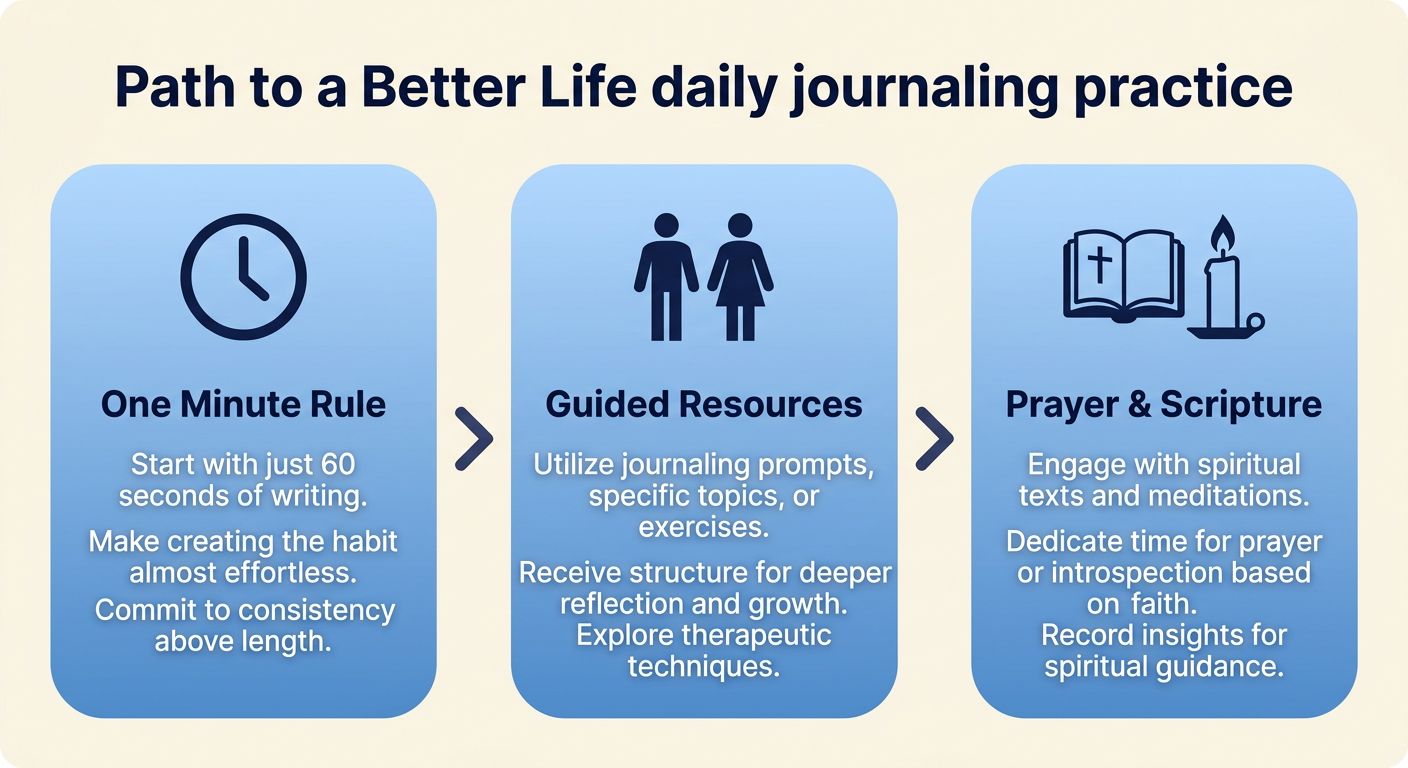
Three-step daily journaling practice for spiritual growth at Path to a Better Life.
Starting with the One Minute Rule
The One Minute Rule is our cornerstone practice for building consistency without overwhelm. The concept is beautifully simple: commit to just sixty seconds of journaling each day. According to Path to a Better Life, this low-barrier entry point removes the pressure to produce lengthy, profound entries, making the habit accessible for a busy parent, a professional with a packed calendar, or anyone who has struggled to maintain a routine. You set a timer, open your journal, and write whatever comes to mind—a gratitude, a worry, a prayer, or a single verse that spoke to you.
This micro-commitment works because it builds the neural pathways of consistency. Over the first 21 days, the one-minute practice naturally expands as writing becomes a welcomed part of your rhythm. You might find yourself reaching for the pen for two or three minutes without prompting. The goal is simply to show up, trusting that small, faithful steps lead to meaningful spiritual formation.
Guided Journaling Resources for Men and Women
We recognize that life’s challenges often differ, so we offer guided journaling prompts tailored specifically for men and for women. Our Men’s Insights section provides reflection exercises addressing work, purpose, and family leadership, while the Women’s Insights resources explore identity, relationships, and personal growth through a faith-based lens. The professional counseling association broadly acknowledges that journaling can be a beneficial tool for emotional clarity and mental well-being.
Please understand that this journaling practice is for spiritual growth and is not a substitute for professional mental health treatment. Results may vary based on individual commitment and circumstances. These guided resources help you process life experiences within a structured framework, asking questions like “Where did I see God at work today?” or “What conversation am I avoiding that needs prayer?” Such prompts turn a blank page into an invitation for honest conversation with God.
Incorporating Prayer and Scripture
The deepest journaling practice happens when prayer and Bible reading converge on the page. Begin by reading a short passage of scripture, then use your journal to respond—this is where spiritual journaling prompts become a dialogue rather than a monologue. You might write a question about the text, rephrase a verse in your own words, or record what you sense God is speaking to your heart. Framing this as “hearing His voice” transforms journaling from a task into an anticipated meeting.
We encourage you to structure this time simply: read, reflect, and write. You could jot down a prayer of thanksgiving, pour out a lambda, or ask for guidance on a decision. Over time, these pages become a personal record of God’s faithfulness. This practice is part of our free 21-day transformation program, and for those who wish to go deeper, our Traveling Companion membership provides daily structured prompts and community support on the road less traveled.
Building this daily rhythm lays a foundation for lasting spiritual growth. The next section will explore the ongoing support and deeper benefits available through our Traveling Companion program, helping you continue this journey with encouragement every step of the way.
Tips for Consistent Spiritual Journaling
Building on the foundation of why journaling matters, here are practical ways to make it a lasting habit. Incorporating spiritual journaling prompts into your daily rhythm can transform sporadic entries into a meaningful spiritual practice that deepens your connection with God’s Story.
Creating a Sustainable Journaling Routine
Start your journey toward consistency by anchoring your journaling to an existing daily habit. Pairing your writing with morning coffee or evening tea creates a natural trigger that signals it is time to reflect. We recommend beginning with just five minutes each day, keeping your chosen format simple and accessible. Some in our community prefer the tactile experience of a physical notebook, while others thrive using a digital app or even voice recordings during a commute. The key is choosing what feels natural to you.
Set a regular time and protect it as you would any important appointment. Treat this appointment as a gentle commitment rather than a rigid obligation. Our Traveling Companion membership provides daily encouragement to help you maintain this rhythm, offering community support when motivation wanes. Remember that consistency matters more than duration. A brief daily entry rooted in gratitude or prayer requests builds momentum over time.
Avoiding Common Pitfalls
Even the most dedicated journalers encounter obstacles, but recognizing them is the first step toward overcoming them. Here are common challenges and practical solutions we have gathered from our community:
- Perfectionism: Embrace “done over perfect.” Use short prompts or The One Minute Rule when you feel stuck, allowing a simple sentence to count as a meaningful entry.
- Inconsistency: If you miss a day, simply resume tomorrow without guilt. A weekly review of entries can reveal patterns and rekindle your commitment.
- Lack of direction: Explore prompt categories such as gratitude lists, prayer requests, or reflections on God’s Story. Our prompt libraries offer structured guidance to spark fresh ideas when you feel aimless.
- Waning motivation: Involve yourself in our community for accountability. Sharing your journey with fellow travelers on the Path to a Better Life provides encouragement and fresh perspective.
Results may vary based on personal commitment; journaling is a spiritual practice and not a substitute for professional mental health care.
Expanding Your Practice Over Time
Once your routine feels established, you can deepen your practice in several ways. Topical Bible study series provide focused themes for extended reflection, while our transformation stories inspire by showing how others have grown through consistent journaling. For those seeking to deepen their study, the association of theological schools offers frameworks that support structured spiritual growth. You might also experiment with rotating through different prompt categories or joining a spiritual journaling group within our Path to a Better Life community. These expansions help keep your devotional life vibrant and engaging.
With these consistency tips, you are ready to explore how journaling can lead to real-life transformation. Hear from our community members in the next section as they share how daily spiritual practices changed their lives for the better.
Embrace Your Spiritual Writing Journey
Have you ever felt a quiet nudge to explore your faith more deeply with spiritual journaling prompts? Spiritual writing is not about perfect grammar or eloquent prose. It is a sacred dialogue with God, a gentle conversation where you pour out your heart and listen for His voice in return. We believe this practice is a cornerstone of the Path to a Better Life, offering a simple way to connect with the divine every day.
We want to reassure you that there is no wrong way to engage in this practice. Whether you fill pages with freewriting, sketch a meaningful doodle, or simply scribble a single heartfelt sentence, it all counts as spiritual writing. This journey is about deepening your spiritual awareness and creating space to hear God speak to you, not about meeting a formal assignment. Begin your session with a simple prayer or a moment of quiet intention, and trust that even short, consistent efforts can lead to profound personal insights over time.
As part of our free 21-day transformation program, this daily habit can become a powerful tool for change. While individual results vary based on personal commitment, we have seen how this practice nurtures emotional resilience and faith. In the next section, we will explore specific prompts to get you started on your own path.
Resources
- Get Free 21-Day Online Spiritual Growth and Healing Program
- Discover How to Donate to Verified Faith-Based Non-Profits
- Join Free 21-Day Spiritual Retreat with Prayer Support
- Discover Free 21-Day Program and Spiritual Mentor Support
- Transform Your Faith with a 21-Day Habit Program
- Discover Christian Self-Help Tools and 21-Day Program
- Discover Inspirational Spiritual Quotes for Personal Renewal
- Discover Professional Counseling Resources from ACA
- Discover ATS Accreditation and Resources for Theological Education