Table of Contents
Peace of Mind Found in the Psalms
One ancient practice that many turn to for inner peace is meditating on the Book of Psalms—a true source of psalms for peace of mind. Engaging in daily scripture meditation for anxiety can help quiet racing thoughts and ground you in God’s promises. A simple breath prayer for anxiety, like slowly inhaling and exhaling while whispering a verse from Psalm 46:10 (“Be still, and know that I am God”), can soothe the spirit.
Our 21-day transformation program incorporates this kind of daily Psalm meditation as a core practice, helping participants build lasting habits of reflection and prayer. We are a crowd-funded organization committed to making these spiritual resources freely available. Path to a Better Life is one of many faith based non profit organizations dedicated to providing spiritual support. While these spiritual practices can support emotional well-being, they are not a substitute for professional mental health advice. Discover these and other resources on our site and start your journey toward a more centered life.
Preparing Your Heart for Psalm Meditation
Finding a quiet space and setting aside five to ten minutes without interruptions creates the foundation for meditating on the psalms for peace of mind. We invite you to approach this time with a gentle openness rather than striving for a specific outcome, allowing the words of scripture to speak into your present concerns.
A simple breath prayer for anxiety can help still your racing thoughts before you begin. As you inhale, silently say, "Lord," and as you exhale, whisper, "quiet my heart." Repeat this rhythm for one to two minutes until your breathing slows and your mind settles. Following this centering practice, choose one short Psalm, such as Psalm 23 or Psalm 46:10, and commit to returning to it each day for a full week. This daily scripture meditation for anxiety helps you move beyond surface reading into deeper, personal engagement with the text.
To sustain this rhythm, consider adopting a daily bible reading plan that provides structure and accountability. Path to a Better Life offers guidance on establishing a consistent habit through manageable daily portions and simple reflection tools. After your meditation, we encourage you to journal one word or phrase that stood out, anchoring the Psalm’s truth in your heart for the day ahead.
Path to a Better Life provides spiritual resources and is not a substitute for professional medical or mental health advice — consult a qualified professional where appropriate. Once your heart is prepared and your breath is still, you are ready to enter into the Psalm itself.
Choosing a Psalm for Peace of Mind
When we yearn for a quiet mind, ancient words can anchor us. Looking for psalms for peace of mind invites us to notice psalms filled with trust, stillness, and the promise of God’s refuge. Psalm 23, Psalm 46:10, and Psalm 131 are classic choices for inner quiet. Choose one that matches your emotional state: Psalm 13 cries out yet lands in trust, while Psalm 62:5–8 offers gentle rest. These psalms for peace of mind are ancient yet timeless. In your daily scripture meditation for anxiety, try reading just one verse slowly and repeating it. You can even turn a key phrase from your chosen psalm into a simple breath prayer for anxiety – inhale the first part and exhale the rest. Path to a Better Life also lists Christian apps with guided psalm readings. Once you have chosen your psalm, let its words shape your quiet time with God. Remember, these spiritual tools support, not replace, professional medical or mental health advice; consult a qualified professional.
Starting a Daily Scripture Meditation Habit
Looking for psalms for peace of mind? Starting a daily scripture meditation habit can transform your mornings. We’ve found that a simple, consistent practice using God’s Word brings calm and focus.
Here are a few steps to get started:
- Choose comforting psalms. Meditate on psalms for peace of mind like Psalm 23, Psalm 46:10, or Psalm 91. Each reminds us of God’s presence and care.
- Practice daily scripture meditation for anxiety. Pick a short verse (e.g., Philippians 4:6–7) and read it slowly while breathing deeply. Let the words replace anxious thoughts.
- Use a breath prayer for anxiety. Inhale, “Lord, you are my peace”; exhale, “I release my fears.” Repeat for a few minutes.
- Start small. We recommend beginning with just 5 minutes each morning. Visit our prayer library for guided meditations that pair scripture with calming music.
Consistency matters most, and our 21-day program is designed to help you build this habit step by step. Remember, scripture meditation is a spiritual practice and not a replacement for professional medical or mental health advice.
Practicing Christian Meditation for Anxiety Relief
When you turn to Psalms for peace of mind, you discover a time-honored way to calm anxious thoughts through Christian meditation. Start by finding a quiet place and choosing a short passage like Psalm 23 or Psalm 46:10. Read it slowly, then repeat it silently while breathing deeply.
One powerful technique is breath prayer for anxiety. Inhale while silently praying, “Lord Jesus Christ,” and exhale, “have mercy on me.” This rhythm helps anchor your mind and soothe distress.
Weaving daily scripture meditation for anxiety into your routine, even for five to ten minutes, steadily builds a sense of God’s presence and peace. Our crowd-funded resources, like the prayer library, can support this practice.
The American Association of Christian Counselors affirms that scripture-based meditation can be a helpful complement to professional care. Remember, this practice is not a substitute for professional mental health advice. For additional guidance and support, explore professional christian counseling resources.
Praying the Psalms When Words Fail
When words fail, the Psalms offer us a ready-made prayer vocabulary, and many discover genuine psalms for peace of mind. These ancient songs give voice to raw emotion and help us connect with God even when we feel empty.
Consider the lament of Psalm 42, where the psalmist pours out longing yet chooses hope. That honest expression models how we can bring our pain directly to God. Pairing a verse like ‘Why are you cast down?’ with slow breathing becomes a breath prayer for anxiety. This practice settles the heart without needing perfect words.
As we learn to pray the psalms, anxious thoughts often quiet—living out the idea of psalms for peace of mind. A habit of daily scripture meditation for anxiety gradually reshapes our inner dialogue toward trust. Over time, praying with Scripture anchors the soul.
If you need a starting place, explore our prayer library at Path to a Better Life. This spiritual practice complements, but does not replace, professional medical or mental health advice.
Building Simple Daily Habits for Spiritual Mental Health
To bring these spiritual principles into your daily rhythm, start with small, manageable habits. One simple habit is turning to psalms for peace of mind each morning, reading a comforting passage like Psalm 23 or 46.
Morning Scripture Meditation. Spend five minutes daily in quiet reflection. Meditating on a psalm of peace helps ground your thoughts; this daily scripture meditation for anxiety can pair perfectly with your morning coffee or bedtime routine.
Breath Prayer. In moments of stress, try this simple breath prayer for anxiety: inhale deeply while praying “Be still,” and exhale “and know that I am God.” Repeat for a minute to restore calm. Consistency matters more than duration—a daily two-minute practice is far more effective than a long, irregular session.
These small steps lay a foundation for lasting spiritual well-being. Our free 21-day transformation program helps you discover a better life in just 21 days—it provides structured guidance, including prayer and music resources—to help you grow. Consider finding a spiritual mentor through Path to a Better Life for added accountability and support. Not a substitute for professional medical or mental health advice; consult a qualified professional where appropriate.
Learning the Breath Prayer: Scripture and Breath
Many people turn to the psalms for peace of mind, and a breath prayer offers a simple way to weave their calming words into a moment of stillness. This practice pairs a short scripture phrase with the rhythm of your breathing.
To begin this daily scripture meditation for anxiety, we can follow three gentle steps:
- First, choose a short verse, aiming for two to four words per phrase.
- Next, inhale slowly while silently repeating the first phrase in your mind.
- Then, exhale slowly while silently repeating the second phrase.
We can repeat this cycle three to five times, allowing the words to anchor our thoughts.
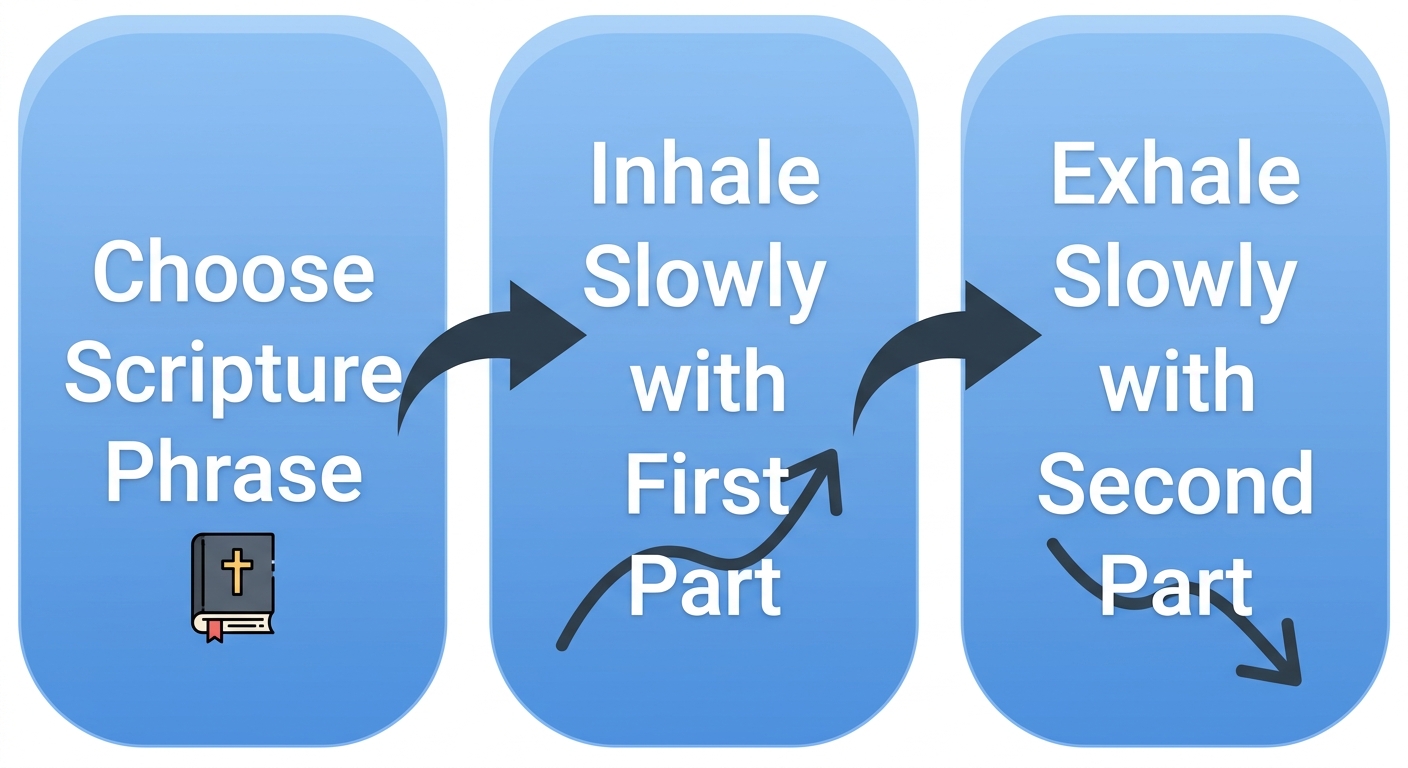
Three-step Christian breath prayer technique
A breath prayer for anxiety may help ground a racing mind, but it is not a substitute for professional mental health support. At Path to a Better Life, we encourage this practice as a spiritual tool, trusting that results will vary for each individual.
Using Short Scripture Phrases During a Panic Attack
When panic rises, turning to psalms for peace of mind gives us an immediate anchor. These short, familiar phrases can interrupt spiraling thoughts and refocus our hearts on God’s steady presence. Remember, this is a calming practice, not a replacement for professional care.
Try repeating "Be still, and know that I am God" (Psalm 46:10) as a breath prayer for anxiety. Inhale slowly, thinking "Be still," and exhale, finishing "and know that I am God." The rhythm calms the body while the truth calms the soul. "The Lord is my shepherd; I shall not want" (Psalm 23:1) reminds us we are cared for in every need, and "The Lord is my light and my salvation—whom shall I fear?" (Psalm 27:1) gently challenges fear with God’s powerful protection.
Practicing daily scripture meditation for anxiety during calm moments helps these truths settle deep within us, so they’re ready when we need them most. With time, we discover a quiet confidence rooted in God’s promises.
Not a substitute for professional medical or mental health advice; consult a qualified professional where appropriate.
Overcoming Common Obstacles in Psalm Meditation
Even with the best intentions, you may hit a few bumps when you begin meditating on the psalms for peace of mind—distraction, emotional heaviness, or simply not enough time. The good news is that these challenges are not signs you’re doing it wrong; they’re a normal part of building a daily scripture meditation for anxiety and stress into your routine. We’ve seen many people work through these same hurdles, and a few simple shifts can make all the difference.
Start small. When an entire psalm feels overwhelming, pick one verse—like Psalm 23:4—and let those words rest with you. Before you read, try a quiet breath prayer for anxiety: “Lord, grant me peace as I read.” Set a timer for five or ten minutes so you’re not watching the clock, and right afterward, jot down one insight in a journal so you don’t lose what you received.
If strong emotions surface, don’t push them away. Sit with the feeling and offer it to God in prayer, letting the psalm hold whatever your heart is carrying right now. These simple practices bring gentle structure to your meditation without turning it into a checklist.
Remember that consistency matters more than perfection. Our 21-day program is built for exactly this rhythm—it gives you a short daily touchpoint so that even when life gets noisy, you keep moving forward. The goal isn’t to master a technique; it’s to create a regular space where you can meet God.
For most obstacles, simple on-the-spot adjustments are enough to keep you showing up. But if emotional barriers persist week after week or you’re struggling with feelings that meditation alone can’t hold, it may be wise to reach out for deeper support. According to the Path to a Better Life FAQ, trained Christian counsellors understand the intersection of spiritual practice and mental health struggles, and they offer a safe place to sort through what’s weighing you down. If you find yourself in that place, consider connecting with christian counselling in Canada. Professional support isn’t a failure of faith—it’s a wise way to care for the whole self that God created, while your psalm practice remains a steady source of daily peace.
Your Ongoing Journey of Peace Through the Psalms
As you finish the 21-day program, the journey toward peace continues. The psalms for peace of mind offer a timeless wellspring you can return to each day. This is your ongoing peace through the Psalms, a practice our community embraces well beyond the initial three weeks.
A Daily Practice of Scripture Meditation
Many program graduates maintain a rhythm of daily scripture meditation for anxiety. Simply select a calming Psalm, read it slowly, and reflect on a single phrase. This Psalm-based meditation is a free, gentle way for us to center our thoughts and invite stillness into a busy day, one verse at a time.
Using Breath Prayer with the Psalms
Pair your reflection with a breath prayer for anxiety. As you inhale, silently repeat a comforting line like "The Lord is my shepherd." As you exhale, release your worries. This praying with the Psalms gently reorients the heart and is a practice we find deeply sustaining. Remember, results vary, and this is not a substitute for professional care. We invite you to learn more about the benefits of completing a 21-day transformation program and discover how our prayer and music libraries can continue to support your well-being.